AI-Native Companies Design Work, Not Software
Centipod ·

Enterprise Architecture has always reflected the technology available at the time. Early computers processed transactions, so organisations built transaction-processing systems. As software matured, those systems evolved into enterprise applications. Service-Oriented Architecture separated responsibilities into reusable services, microservices made them independently deployable, and cloud computing changed where software ran and how quickly it evolved.
Each technological wave changed how we designed systems, yet one assumption remained remarkably constant. Software existed to help people perform work. That assumption shaped organisations as much as technology. Business capabilities were mapped to applications, applications were divided into components, and employees learned to navigate screens and workflows. Success meant helping people complete their work faster, more accurately and more consistently.
Artificial intelligence changes that relationship. AI no longer only supports work. It can interpret information, make bounded decisions, coordinate activities and increasingly perform operational tasks. That raises a more fundamental question than where to add an AI assistant. Perhaps we should stop asking which applications we need and start asking what work the organisation actually performs.
Every technology revolution changes the design
History shows that technology creates the greatest value when it allows us to redesign work rather than simply automate it. The steam engine transformed factories because production was reorganised around mechanical power. Electricity achieved its greatest gains when factories abandoned central drive shafts and redesigned production lines. Computers followed the same pattern. Early systems copied paper forms and filing cabinets. The real breakthrough came when organisations realised many of those processes no longer needed to exist.
AI presents the same opportunity. Many organisations are trying to insert AI into existing applications. That improves productivity, but it does not necessarily create an AI-native organisation. Every previous technological revolution eventually redesigned the way work was organised. AI gives us the opportunity to do exactly the same.
Applications are no longer the starting point
Traditional architecture begins with business capabilities and then identifies the applications needed to support them. That approach made sense because applications were where work happened.
An AI agent experiences an organisation very differently. It does not care whether information comes from an ERP platform, a CRM system or a document repository. It needs a clear objective, reliable information, defined authority and measurable outcomes. From its perspective, the application becomes one possible executor of the work rather than the centre of the architecture.
This changes the first architectural question. Instead of asking which application owns a capability, we should ask which tasks create value and what those tasks require to succeed. Applications become implementation choices rather than the organising principle of the enterprise.
Work should become a first-class architectural concept
Enterprise Architecture already describes business, processes, applications and technology. What it rarely models explicitly is the work itself.
People bridge the gaps between systems every day. They interpret incomplete information, resolve exceptions, apply judgement and decide what should happen next. Much of that knowledge has traditionally lived inside applications or inside people's heads. That worked because people supplied the missing intelligence. Autonomous AI cannot rely on undocumented organisational knowledge.
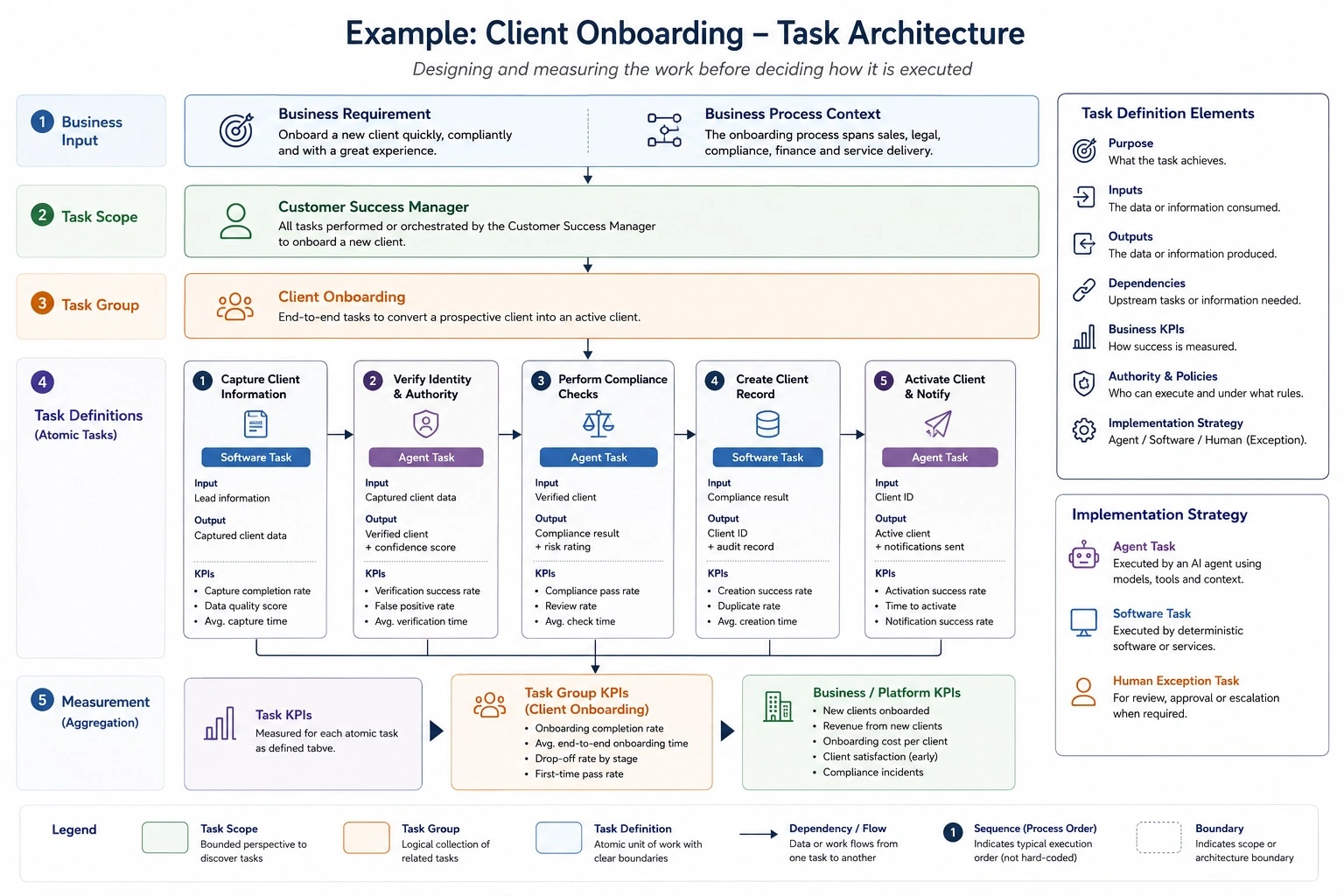
Every task therefore needs a clear purpose, defined inputs and outputs, business rules, constraints and escalation paths. Those characteristics belong to the work itself, not to the application or team performing it.
Consider customer identity verification. The objective remains exactly the same whether it is performed by a customer service employee, an application, an automated workflow or an AI agent. The work is stable. Only the executor changes. By separating work from execution, organisations can evolve continuously without redesigning the underlying architecture every time technology changes.
A different architectural model
This naturally leads to four connected architectural perspectives.
Business Intent explains why the work exists. It captures objectives, policies and strategic priorities.
Work defines what must be accomplished, including the required information, expected outcomes and business constraints, without assuming who performs it.
Execution records who or what currently performs the work. That may be a person, an application, a software service or an autonomous agent. Unlike the work itself, execution is expected to change over time.
Technology provides the infrastructure, AI models, platforms and interfaces that enable execution.
Together these perspectives create a simple chain. Business Intent explains why. Work defines what. Execution determines who, or what, performs the work. Technology provides where it runs. Each perspective answers a different architectural question and should evolve independently.
Designing organisations that evolve
This separation changes AI transformation from a series of disruptive replacement programmes into a continuous process of controlled improvement. Customer onboarding can gradually move from manual execution to AI-assisted workflows. Claims processing can become increasingly autonomous. Procurement may combine people, software and AI agents depending on complexity, while high-risk decisions continue to require human approval.
Throughout this transition, the work itself remains stable. What changes is the way it is executed. Governance also becomes clearer because human approval, regulatory controls and ethical boundaries become explicit characteristics of execution instead of assumptions hidden inside applications.
Cloud computing changed where software runs. Microservices changed how software is constructed. Artificial intelligence changes who, or what, performs the work.
That is why AI-native architecture is not primarily about building smarter applications. It is about designing work independently from the mechanism that performs it. Applications, people and AI agents all become possible executors of the same well-defined task. The organisation first decides what must be accomplished. Only then does it decide who, or what, is best placed to accomplish it.
 This article was created by people. We have used artificial intelligence (AI) to help articulate our message and refine the text. AI was employed as a tool to assist with structuring, identifying grammatical and spelling errors, and improving readability. The final document has been carefully reviewed and approved by our team.
© Centipod B.V., 2026