Why Work Is Becoming the Centre of Enterprise Architecture
Centipod ·
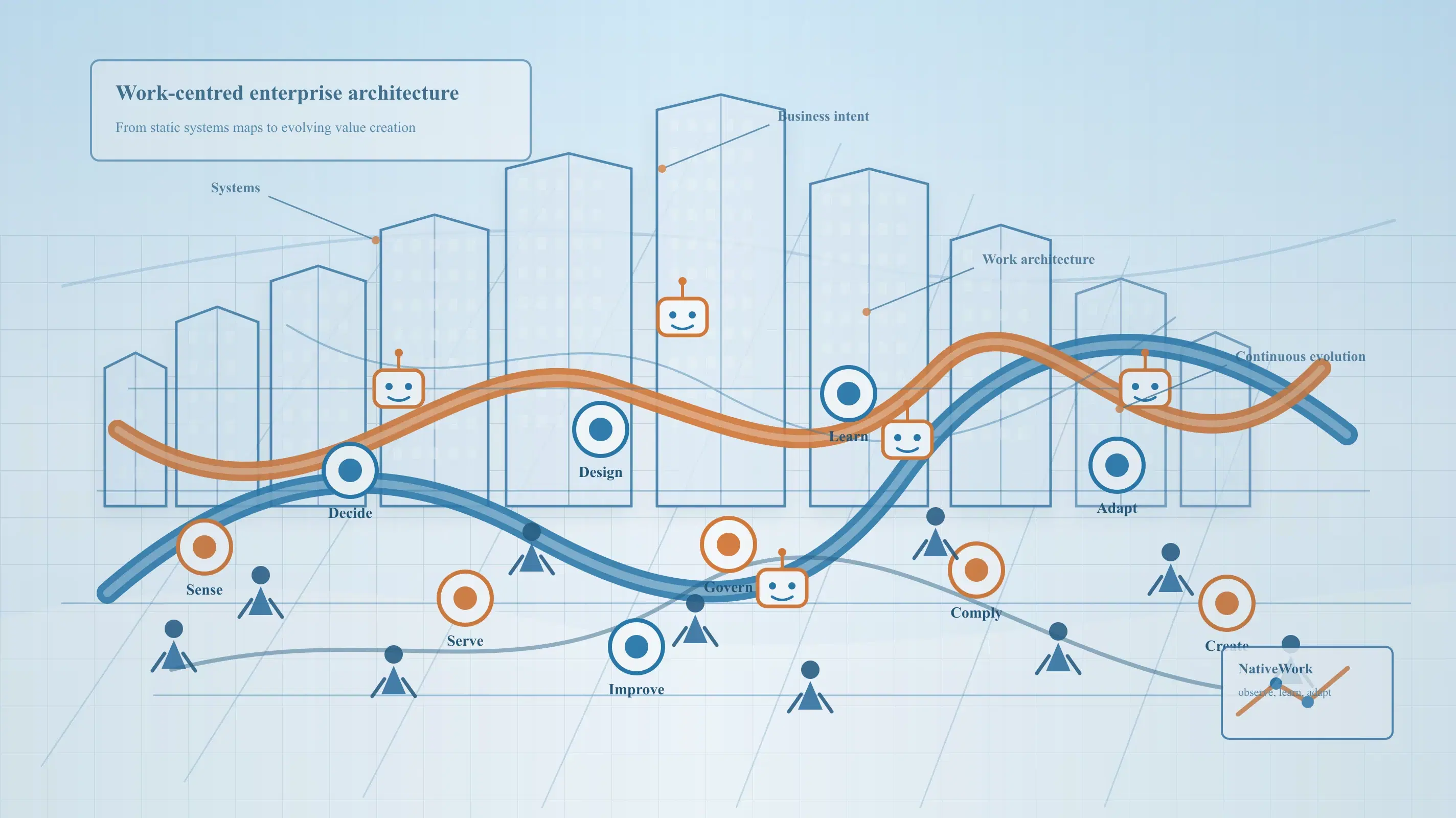
In the first article of this series, we suggested that Enterprise Architecture may be approaching the limits of the optimisation problem it was designed to solve. That observation naturally raises another question.
If systems are no longer the primary thing we should optimise, what is?
For decades the answer appeared obvious. Organisations invested enormous effort in designing application landscapes, defining integration patterns and improving data management. These remain essential disciplines because every organisation depends on reliable technology.
Yet executives rarely ask whether their application portfolio creates value.
They ask whether the organisation delivers value.
The distinction matters.
Customers never buy an application landscape. Citizens never experience an integration platform. Shareholders never invest because an organisation has a beautifully documented target architecture.
They experience the work the organisation performs.
That work includes serving customers, making decisions, complying with regulations, designing products, managing risk and creating new opportunities. Technology exists to enable those activities, not the other way around.
Artificial intelligence changes this relationship in a subtle but profound way.
For the first time, significant parts of that work can be performed by different combinations of people, AI and software. The same outcome may be achieved in several different ways. What matters is no longer who performs the work, but how effectively the enterprise delivers the outcome.
The architectural focus therefore begins to move.
Instead of asking how systems support work, we increasingly need to ask how work itself should be organised, measured and continuously improved.
That requires a different architectural perspective.
At Centipod we have been exploring this challenge through an emerging Enterprise Architecture paradigm called NativeWork™.
Rather than treating work as something that happens inside applications or business processes, NativeWork starts from the premise that work itself deserves first-class architectural attention. Systems, information, execution mechanisms and technology remain essential, but they become supporting perspectives rather than the centre of the model.
This way of thinking also changes how organisations evolve.
Traditional transformation programmes often begin by defining a future target state before spending years attempting to reach it. By the time the programme finishes, business priorities and technology have frequently moved on.
AI accelerates that problem.
Capabilities improve every few months. Regulations evolve. Markets shift. Competitive advantages appear and disappear rapidly. Organisations can no longer afford to redesign themselves only during major transformation initiatives.
They need to evolve continuously.
We refer to this as Continuous Enterprise Evolution.
The objective is not endless change for its own sake. It is the ability to adapt work continuously while maintaining governance, accountability and business stability.
Achieving that requires a common language.
Business leaders, architects, engineers and increasingly AI systems need to describe work in consistent ways that can be understood across organisational and technical boundaries.
Alongside NativeWork, we are therefore developing WorkML™, a language designed to express AI-native enterprise architectures in a form that can be understood by both people and intelligent systems. It is still evolving, but its purpose is straightforward: to provide a common language for describing how modern enterprises create value.
The details will come later.
For now, the more important observation is this.
Enterprise Architecture has always helped organisations understand what they have built.
The next generation of Enterprise Architecture may need to help organisations understand how they work.
That is a very different question.
If it is the right question, much of what follows may need to change.
About NativeWork
NativeWork™ is an emerging Enterprise Architecture paradigm developed by Centipod for AI-native organisations. It focuses on Continuous Enterprise Evolution by placing work, rather than systems, at the centre of enterprise design.
WorkML™ is the accompanying modelling language currently under development.
Learn more at https://nativework.org.
NativeWork™ and WorkML™ are trademarks of Centipod. Trademark applications are pending.
This article was created by people. We have used artificial intelligence (AI) to help articulate our message and refine the text. AI was employed as a tool to assist with structuring, identifying grammatical and spelling errors, and improving readability. The final document has been carefully reviewed and approved by our team.
© Centipod B.V., 2026