The Enterprise Is Becoming Executable
Centipod ·
For most of the software era, there has been a reasonably clear boundary between an organisation and the technology that supports it.
The organisation defined policies, employed people, made decisions and established processes. Software recorded transactions, moved information and automated parts of those processes. Enterprise Architecture helped keep the relationship between the two understandable.
That boundary is becoming less clear.
A policy can now influence an AI agent directly. Knowledge can be used during execution rather than merely stored for somebody to read. Decisions that once required a person can be supported or performed by AI under defined conditions. Work can move between a human, an AI agent and conventional software without changing the business outcome it is intended to achieve.
Something important is happening here. More of the enterprise is becoming executable.
Executable does not mean automated
The word "executable" can easily be misunderstood. It does not mean that the entire organisation becomes software, nor does it imply an autonomous company run by algorithms.
An executable enterprise is one in which increasingly more of the logic that determines how work happens can be connected to the work itself.
Consider a relatively ordinary decision such as approving a customer application. There may be rules about eligibility, information that must be verified, evidence that must be available, thresholds for escalation and people who remain accountable for particular outcomes.
Traditionally, much of this logic is scattered across process documentation, policy documents, application code, employee knowledge and organisational procedures. The business knows roughly how the decision works, but there may be no single architectural representation of it.
AI makes that fragmentation much harder to tolerate.
If an AI agent is allowed to participate in the decision, it needs to know what it may do, which information it can use, when it should stop, when a person must become involved and what outcome it is trying to achieve. The implicit organisation suddenly needs to become explicit.
This is one of the deeper consequences of AI that is easy to miss when the discussion remains focused on models and applications.
We have architected around execution
Enterprise Architecture has traditionally described many things surrounding work. We model business capabilities, processes, applications, information, integrations and technology. All of these are useful perspectives, but the actual unit of work being performed can remain surprisingly implicit.
That was manageable when execution was relatively stable.
A person performed a particular activity using a particular application. An application automated another part. A workflow connected them. The boundaries were sufficiently predictable that architecture could concentrate on the supporting structures.
Now imagine that the same piece of work can be executed differently next year, next month or even according to the circumstances of a particular case.
A person may perform it when judgement is required. An AI agent may perform most of it when the evidence is clear. A conventional service may handle the deterministic parts. A person may then review only exceptional cases.
If architecture remains centred on the systems performing the work, every change in execution looks like an architectural change.
If architecture starts with the work, the picture becomes different. The work remains recognisable while the means of execution can evolve around it.
That is a much better foundation for an AI-native enterprise.
Why this matters to the business
This distinction may sound architectural, but its value is very practical.
AI capabilities are changing quickly. Organisations understandably hesitate to redesign critical operations around technologies that may look very different in two years. They also need to manage risk, regulation, accountability and existing technology investments.
Separating the work from its execution mechanism reduces that tension.
An organisation can define what needs to be achieved, what information is required, which boundaries apply and how success is measured without permanently binding those things to a specific implementation.
The execution choice can then change as circumstances change.
That creates options.
A task performed manually today can gain AI support without redefining its business purpose. An AI service can be replaced if a better one becomes available. A heavily automated activity can return to human review when risk increases. Legacy systems can remain part of execution until replacing them creates sufficient value.
Continuous Enterprise Evolution becomes practical because improvement does not require the whole architecture to be repeatedly redesigned.
This also changes technology investment. The question becomes less about whether a particular AI product should become a strategic platform and more about where a different execution approach creates measurable business value.
That is a healthier conversation for both executives and architects.
The governance problem becomes clearer too
Greater execution flexibility does not reduce the need for governance. It increases it.
When work is tightly coupled to one application and one organisational role, many controls are embedded in that arrangement. Some are documented and others simply exist because there is only one practical way to perform the work.
Once execution becomes dynamic, those assumptions disappear.
The organisation needs to know which outcomes are acceptable, what evidence is required, who owns the work, which decisions may be delegated, where accountability remains and under which circumstances execution must escalate.
This is why simply adding AI governance to the existing technology architecture is not enough.
The governance must connect to the work.
The same principle applies to measurement. Measuring whether an AI service responded correctly is useful, but the business ultimately cares whether the work produced the required outcome. Technical performance and business performance are related, but they are not the same thing.
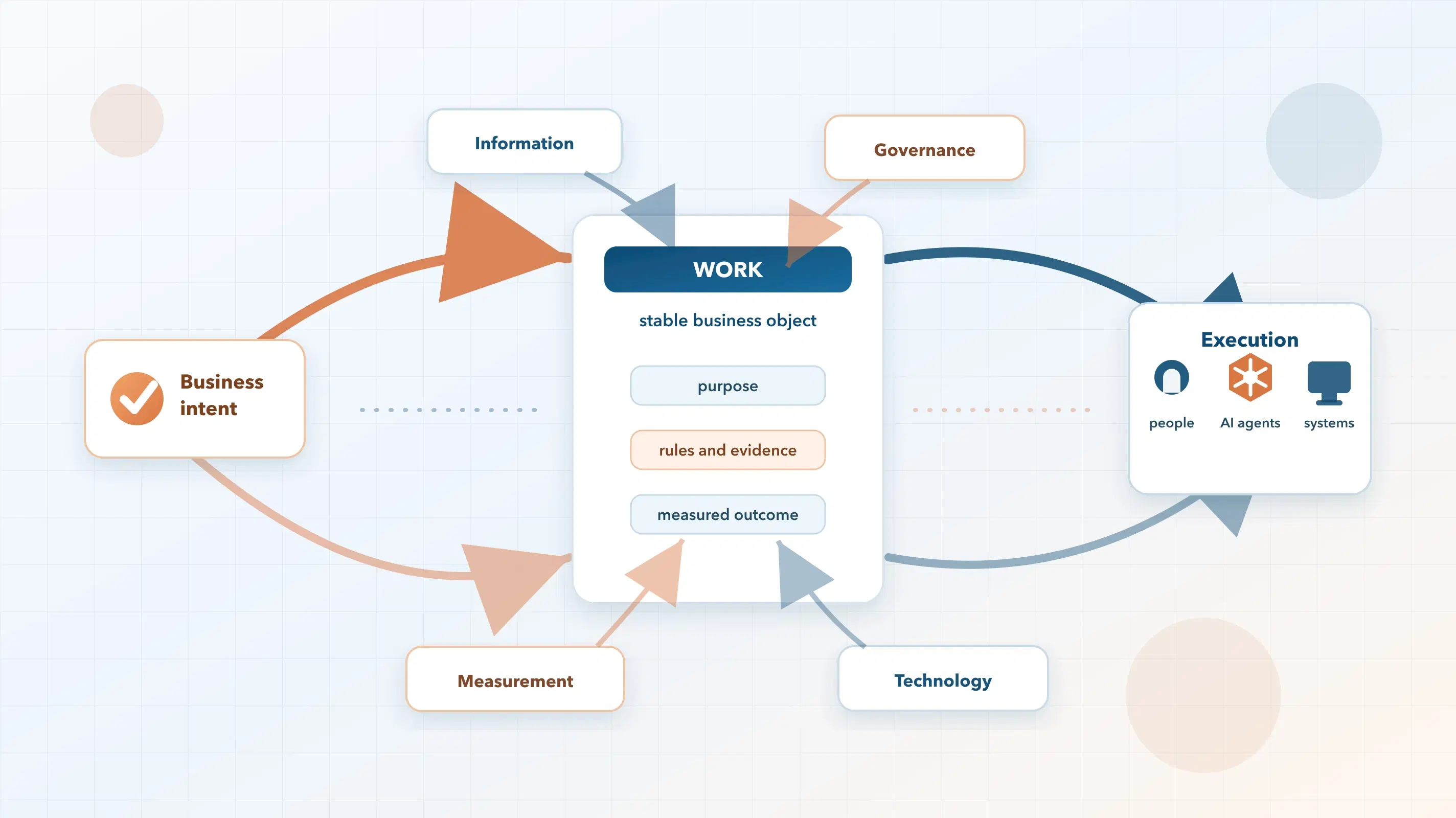
An executable enterprise therefore requires architecture that can connect intent, work, information, execution, governance and measurement.
This is where classical EA runs out of road
This brings us back to the uncomfortable argument running through this series.
Enterprise Architecture is becoming intellectually bankrupt when it continues to treat applications and technology structures as the natural centre of enterprise design while the nature of execution itself is changing.
That does not mean the existing architectural perspectives are useless. Information Architecture remains essential. Technology Architecture remains essential. Business Architecture remains essential.
The problem is the relationship between them.
If work can be performed by people, AI and software interchangeably, architecture needs something stable around which those perspectives can organise themselves.
We believe that stable object is the work.
Once work becomes explicit, the surrounding architecture can change without losing meaning.
That is an important difference between using AI within today's enterprise architecture and designing an enterprise that is genuinely AI-native.
NativeWork starts with the work
This principle sits at the centre of NativeWork™.
NativeWork is the Enterprise Architecture standard and method we created for designing organisations in which work can evolve independently from the technologies and actors that execute it.
Its architectural sequence deliberately starts from the business and moves through the work before determining the information, execution and technology required to support it. The Task is therefore a primary architectural object rather than something inferred later from processes or applications.
WorkML™ provides the language through which these architectural structures can be expressed in a consistent and machine-readable way.
This matters because an architecture intended for an AI-native organisation cannot exist only as diagrams that people periodically interpret. Increasingly, the architecture itself needs to become something that people and AI can reason over.
We will explore that implication later in this series.
For now, the important distinction is simpler. NativeWork does not start by deciding where AI belongs in the existing application landscape. It starts by understanding the work the enterprise needs to perform and then asks what should execute it.
Sometimes that answer will be AI.
Sometimes it will be conventional software.
Sometimes it will remain a person.
Good architecture should allow that answer to change.
From architecture as description to architecture as capability
For many years, one of Enterprise Architecture's main responsibilities has been to describe the enterprise well enough to guide change.
The Executable Enterprise asks more from architecture.
Architecture must increasingly help determine how the enterprise operates while providing enough stability for the way it operates to keep changing. That requires clearer boundaries between business purpose and execution, stronger connections between governance and work, and measurement that follows outcomes rather than merely systems.
This is where Continuous Enterprise Evolution becomes more than an attractive idea.
An enterprise can evolve continuously when the work it needs to accomplish remains understandable while the way that work is executed can change safely around it.
The architectural challenge of the AI era may therefore be quite different from the one we inherited from the software era.
It is no longer enough to architect the technology that supports the enterprise.
We increasingly need to architect the enterprise in a form that can be executed.
About NativeWork
NativeWork™ is an AI-native Enterprise Architecture standard and method developed by Centipod. It places work at the centre of enterprise design and provides an architectural foundation for Continuous Enterprise Evolution.
WorkML™ is the accompanying language for expressing NativeWork architectures in a form designed for both people and intelligent systems.
Learn more at nativework.org.
NativeWork™ and WorkML™ are trademarks of Centipod. Trademark applications are pending.
This article was created by people. We have used artificial intelligence (AI) to help articulate our message and refine the text. AI was employed as a tool to assist with structuring, identifying grammatical and spelling errors, and improving readability. The final document has been carefully reviewed and approved by our team.
© Centipod B.V., 2026