Do Androids Dream of Electric Sheep?
Centipod ·
For decades, Philip K. Dick’s Do Androids Dream of Electric Sheep? has shaped how we imagine the future of robotics. Whether through the novel itself or its film adaptation Blade Runner, it left us with a powerful image of intelligent machines that look and behave like people. Even today, when someone talks about robots, many of us instinctively picture a humanoid.
It is a compelling vision. If robots are going to work alongside us, surely they should be built like us.
History, however, suggests something different.
Every major technological revolution has changed the way we work, but none of them began by replacing people. They began by solving a specific problem, creating value, and only then reshaping entire industries around that new capability.
The steam engine is a good example. It did not replace workers. It replaced the need to generate mechanical power by hand, by waterwheel, or by horse. Once reliable power became available, factories no longer had to be built around rivers or organised around manual labour. Production changed because the process changed.
Electricity followed the same pattern. Early factories simply swapped steam engines for electric motors, but the real breakthrough came later. Engineers realised that every machine could have its own motor instead of relying on one large engine driving belts throughout the building. Factory layouts became more flexible, production lines became more efficient, and entirely new ways of manufacturing emerged.
Computers repeated exactly the same story. The first business systems often did little more than digitise paper. Forms became electronic forms and filing cabinets became databases. It took years before organisations realised they no longer needed many of those processes at all. The greatest gains came from redesigning the business, not from copying it onto a screen.
Looking back, every industrial revolution followed the same path. Technology first automated individual tasks. Those successes generated confidence, investment, and practical experience. Only then did organisations rethink how work itself should be organised.
That is why I sometimes wonder whether robotics is taking an unusual path.
Much of today’s investment is aimed at humanoid robots. The ambition is understandable. Build one machine that can perform almost any physical task a human can perform, and it could work almost anywhere.
It is an extraordinary engineering challenge, but it also raises an interesting question. Are we designing robots to solve business problems, or are we designing them to fit into a world that was built entirely around humans?
A humanoid robot needs to balance because it has two legs. It needs highly dexterous hands because our tools were designed for human hands. It needs to navigate stairs, corridors, and doorways because our buildings were designed for people.
These are genuine technical challenges.
Many of them also exist because we chose to start with the shape of the solution rather than the nature of the problem.
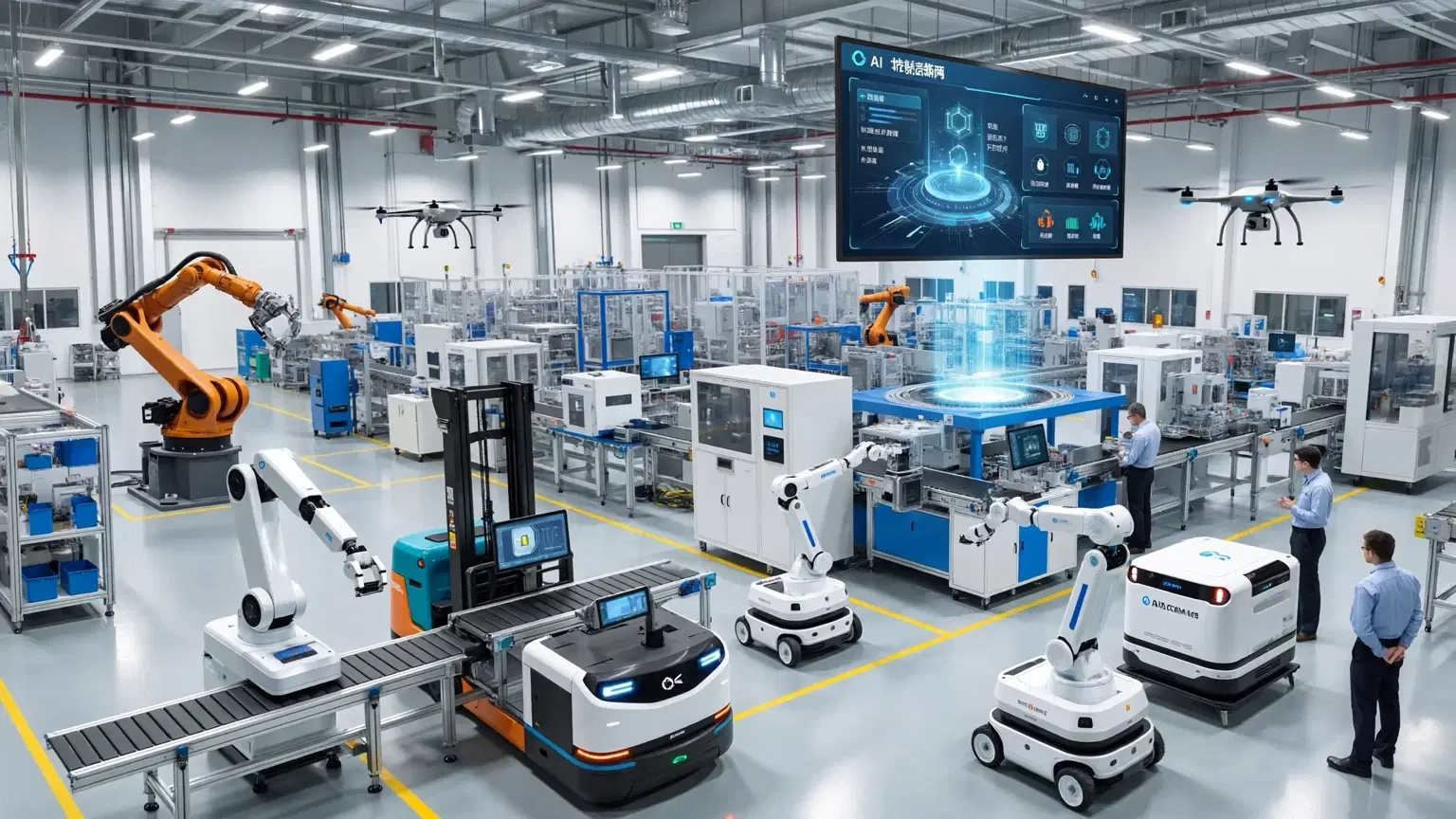
Imagine designing a warehouse from scratch today. Would the optimal solution really consist of dozens of humanoid robots carrying boxes from shelf to shelf? Or would it be an intelligent combination of autonomous forklifts, conveyor systems, robotic arms, inventory drones, and mobile robots, each designed for a single purpose and coordinated by a shared AI platform?
The second option feels much closer to how previous technological revolutions unfolded.
Artificial intelligence makes this approach even more attractive. Throughout history, every machine required its own operator because intelligence lived inside the person using it. Today, intelligence can be shared. A single AI platform can coordinate hundreds or even thousands of specialised machines, allowing each one to focus on doing one job exceptionally well.
We have already seen this happen in software engineering. Modern applications are no longer built as one enormous program responsible for everything. Instead, they consist of many specialised services working together. Each service has a clear responsibility, while the intelligence emerges from the way they are orchestrated.
Robotics may evolve in much the same way. The overall system becomes highly adaptable, even if the individual robots are not.
This also creates a very different innovation model. Purpose-built robots deliver measurable value today. A cleaning robot reduces labour costs. An inspection drone improves safety. An autonomous inventory robot increases accuracy. A robotic loading system improves throughput. Each deployment solves a real business problem and generates operational experience, data, and budget for the next improvement.
Over time, these individual solutions become connected. Data flows between systems, AI becomes better at coordinating them, and organisations gradually become robot-native. Not because they introduced one revolutionary machine, but because they continuously removed friction from hundreds of everyday activities.
None of this means humanoid robots have no future.
There will always be environments that cannot easily be redesigned. Homes, construction sites, emergency response, and maintaining existing infrastructure all require flexibility that specialised machines may struggle to provide. In those situations, humanoid robots could become incredibly valuable.
The mistake would be assuming that these exceptional environments define the future of robotics as a whole.
History tells us something else. Every industrial revolution created the greatest value by redesigning systems rather than replicating people. Perhaps robotics will follow the same path.
Instead of asking how to build a robot that can do every job, we may achieve far more by asking how to redesign work so that every job is performed by the system best suited to it.
That system may include humanoids.
But it almost certainly will not depend on them.
This article was created by people. We have used artificial intelligence (AI) to help articulate our message and refine the text. AI was employed as a tool to assist with structuring, identifying grammatical and spelling errors, and improving readability. The final document has been carefully reviewed and approved by our team.